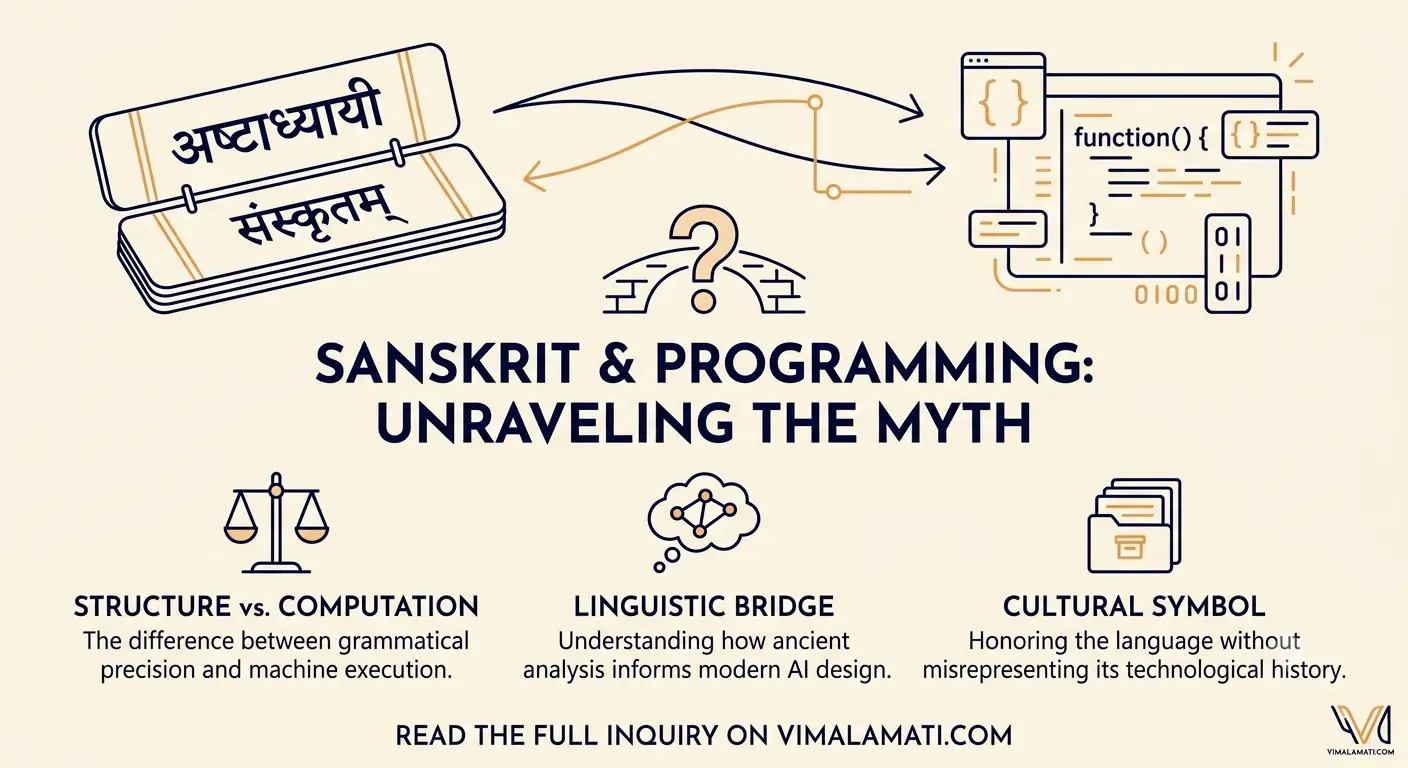
The idea that Sanskrit—the classical language of the Vedas, epics, and profound philosophical treatises—could serve as a modern computer programming language is a popular and evocative notion. It speaks to our human desire to bridge the gap between ancient wisdom and cutting-edge technology.
To understand the truth behind this, we must look at the intersection of computational linguistics and formal grammar.
The “Sanskrit as Programming Language” Myth:
The common belief largely stems from a 1985 paper by Rick Briggs titled “Knowledge Representation in Sanskrit and Artificial Intelligence.” Briggs suggested that the highly structured, rule-based grammar of Sanskrit could be analogous to the formal languages used in AI.
The Reality: Sanskrit is a natural language (one spoken and written by humans for millennia), whereas programming languages are artificial formal languages designed for machine execution. While they share some “logical” characteristics, they serve fundamentally different purposes.
The Intersection: Where Ancient Logic Meets Modern Code:
To appreciate why this comparison keeps resurfacing, we have to look at the work of the ancient grammarian Pāṇini (c. 4th century BCE).
- Pāṇini’s Aṣṭādhyāyī: This monumental work describes the grammar of Sanskrit with such precision, economy, and procedural logic that it is often cited as the precursor to the Backus-Naur Form (BNF)—the notation used to define the syntax of programming languages today.
- Generative Rules: Pāṇini did not just describe words; he created an algorithmic system of rules (rules > derivation > valid sentences). If you follow his set of algebraic-like steps, you can generate an infinite number of grammatically correct Sanskrit sentences.
- The “Charm” for Experts: Computational linguists find Pāṇini “charming” because his grammar functions almost like a deterministic state machine. He proved that human language could be reduced to a highly rigorous, logical structure.
Why Sanskrit isn’t a Programming Language:
Despite its logical brilliance, Sanskrit cannot be “coded” in the way we use Python, C++, or Java for a few core reasons:
| Feature | Natural Language (Sanskrit) | Programming Language |
| Ambiguity | Inherently contextual and poetic. | Must be 100% unambiguous for a CPU. |
| Purpose | Expressing human thought, emotion, philosophy. | Instructing hardware to perform specific tasks. |
| Error Handling | Flexible; intent is often understood despite errors. | Fatal; a single misplaced semicolon crashes the system. |
| State | Dynamic and fluid. | Precise, binary-based state management. |
The Verdict: A Legacy of Structure, Not Syntax:
Sanskrit is not a computer programming language, and attempting to turn it into one would likely strip away the very beauty that makes it “Sanskrit”—its capacity for nuance, metaphor, and infinite flexibility.
However, the “naive belief” is rooted in a profound truth: Pāṇini’s work effectively invented the concept of a formal system. When programmers study Sanskrit, they are not learning a new way to write software; they are witnessing the historical birth of algorithmic thinking. Sanskrit is not the code that runs the computer; it is the philosophical ancestor of the logic that allows us to build computers in the first place.
The Semicolon and the Sutra:
To call Sanskrit “the best language for computers” is ultimately like calling a Stradivarius violin “the best tool for hammering nails”—it misses the entire point of the instrument. Pāṇini certainly gave us the world’s first formal, rule-based grammar system, but he was mapping the heights of human consciousness and natural speech, not trying to get a machine to print “Hello World.” After all, if Pāṇini had been writing C++, a single missed semicolon in the Aṣṭādhyāyī would have thrown a fatal syntax error and halted the entire classical Indian tradition! Instead, let us honor the ancient grammarians for what they actually accomplished: creating a system so breathtakingly structured that modern computer scientists are still trying to catch up to it.
