The Architects of Cosmic Dawn: Deciphering the Jain Concept of the Śalākāpuruṣas (शलाकापुरुष)
To gaze into the heart of Indology is to confront civilizations that did not merely record history, but measured it in heartbeats of cosmic dimensions. While Western antiquity tracked time through the linear rise and fall of mortal empires, and Vedic traditions conceptualized cyclical epochs governed by cosmic preservation, Jainism unveiled a breathtakingly mathematical and beautifully narrative universe. At the absolute core of this Jain cosmology stands the concept of the Śalākāpuruṣas (शलाकापुरुष)—the Sixty-Three Illustrious Great Beings [1] who emerge, epoch after epoch, to anchor the moral, spiritual, and temporal axes of our world.
For the layman, these figures are the titans of epic myth: supreme teachers, world-conquering emperors, and divine brothers locked in eternal combat with the forces of tyranny. For the expert Indologist, philologist, and philosopher, the Śalākāpuruṣas represent a sophisticated, highly structured structural framework designed to resolve a fundamental existential paradox: How does an uncreated, infinite universe without a central creator-god maintain its ethical equilibrium and historical continuity?
The Architecture of the Cosmic Wheel: Kālacakra (कालचक्र)
To understand these illustrious beings, one must first grasp the engine of Jain time—the Kālacakra (कालचक्र), or the cosmic wheel. Time is not a straight line rushing toward an apocalypse, but an infinite, double-sided pendulum. It swings upward through Utsarpiṇī (the era of progressive evolution) and downward through Avasarpiṇī (the era of cosmic decline).
We currently inhabit the Avasarpiṇī phase, a long twilight where human stature, lifespan, and moral fortitude naturally diminish. Yet, the universe does not abandon itself to chaos. During the specific epochs of this cycle, exactly sixty-three supreme souls—having purified their consciousness across countless previous reincarnations—take birth. They are the “Torchbearers.”
The title Śalākāpuruṣa itself carries profound semantic weight. Śalākā historically refers to a marker, a voting rod, or a divine stylus used to engrave gold leaf. Thus, these are the “Men of the Stylus”—beings whose lives are indelibly etched into the golden fabric of cosmic memory, serving as the immutable reference points for human civilization.
कालचक्र (Kālacakra): The Mathematical Mechanics of Cyclic Time
Vimalamati.com
Beyond Linear Eschatology: The Six-Spoked Wheel and the Invariable Geometry of the Śalākāpuruṣa
The Calculus of the Ara Eras
Jain cosmology structures each half-rotation of the wheel into six distinct epochs known as आरा (Ārā). These periods operate on staggering chronological scales measured in सागरोपम (Sāgaropama—ocean-years based on cosmic time intervals), mapping a precise trajectory where virtue, height, and lifespan mathematically decline from absolute bliss to total deprivation before rising again.
The Invariant 63 of Universal History
The appearance of the sixty-three शलाकापुरुष (Śalākāpuruṣa)—comprising 24 तीर्थंकर (Tīrthaṅkaras), 12 चक्रवर्ती (Universal Monarchs), 9 वासुदेव, 9 प्रतिवासुदेव, and 9 बलभद्र—is not a random historical accident. It is an immutable structural law of Jain universal history (महापुराण – Mahāpurāṇa), acting as moral anchors that recurrently re-establish the path of liberation across every descending and ascending cycle.
Advanced Indological Insight: The Ontological Status of Time and Kāla as a Substance
To understand the profound uniqueness of the Jain Kālacakra, one must look to द्रव्यसंग्रह (Dravyasaṅgraha) and the ontological classification of काल (Kāla). Unlike systems that treat time merely as an abstract mental concept or a relative dimension, Jainism treats time as a literal, non-corporeal substance (*akāyika dravya*) composed of countless infinitesimal units (*kālāṇu*) that passively assist in the motion, change, and modification of all other living (*jīva*) and non-living (*ajīva*) entities. The turning of the wheel is therefore not an arbitrary divine decree, but the mechanical interplay of karmic density and cosmic substance unfolding across infinite, unbeginning time.
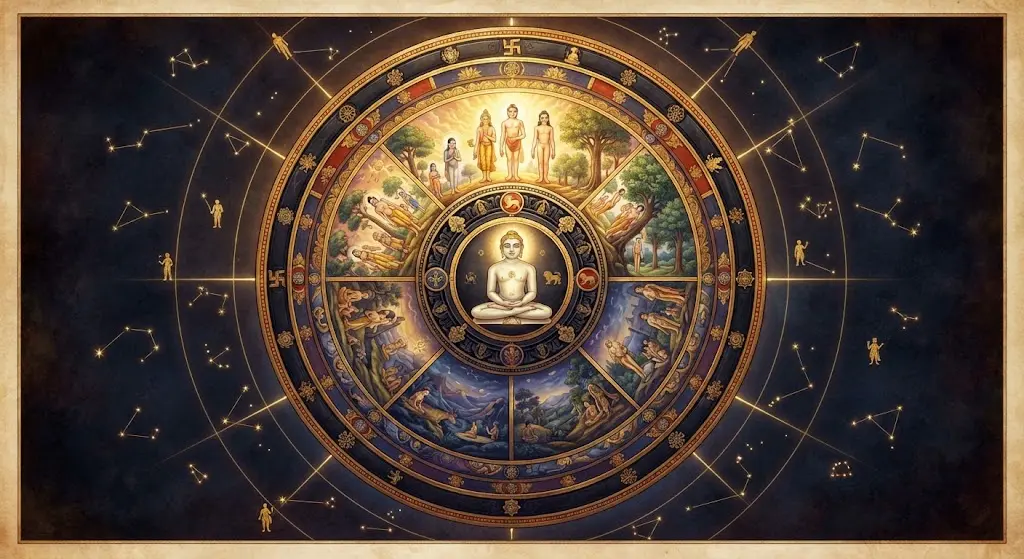
Visualizing the कालचक्र (Kālacakra): Iconography and Cosmic Geometry
Vimalamati.com
Ecclesiastical Blueprint for an Elaborate Manuscript Illumination or Digital Artwork
Foreground & Central Motif
At the heart of the canvas stands a massive, multi-tiered wheel of time carved from polished black basalt and inlaid with fine gold leaf. The wheel is divided into six distinct alternating wedges representing the *Ārās* of ascending and descending time, with its hub anchored by a luminous, serene Tīrthaṅkara seated in full lotus posture (पद्मासन – Padmāsana), unaffected by the turning motion around him.
Atmospheric Background & Symbolism
The background depicts a sweeping cosmic landscape: the upper half glows with golden light representing the ascending arc (*Utsarpiṇī*), while the right side transitions into a twilight blue representing the downward pull of *Avasarpiṇī*. Subtle golden stylus lines (*śalākā*) trace across the heavens, connecting sixty-three faint stellar constellations that mirror the celestial positions of the *Śalākāpuruṣa*.
Curatorial Aesthetic Guide
Styled after classical Pāla manuscript paintings and Jain cosmological diagrams (*Lokākāśa*), the color palette relies on deep indigo, burnished gold, vermilion red, and parchment ivory. This visual composition embodies the concept that while historical epochs inevitably decay, the structural landmarks of human awakening remain eternally preserved in the fabric of the cosmos.
The Five Typologies of Greatness
The Five Typologies of Greatness
Vimalamati.com
Spiritual Sovereignty, Imperial Rule, and Epic Re-interpretations
Inner Mastery & Outer Empire
The structural matrix balances the supreme ascetics—the twenty-four तीर्थङ्कर (Tīrthaṅkaras) who forge the bridge across Samsāra—with the twelve चक्रवर्ती (Cakravartins), who achieve the absolute zenith of material power before discovering its ultimate transience and renouncing the crown.
The Dramatic Triads
The remaining entities operate within twenty-seven tight dramatic units. Comprising the pacifist बलभद्र (Balabhadra), the dynamic warrior नारायण (Nārāyaṇa), and the hubristic प्रतिनारायण (Pratinārāyaṇa), these triads systematically restructure classical epic narratives like the Rāmāyaṇa and Mahābhārata through the lens of karmic consequence.
Indological Matrix: Karma and the Epic Reversion
By routing cosmic conflict through structured brotherly pairs where the violent destruction of the tyrant falls strictly on the dynamic younger sibling, Jain narratives reconcile heroic action with the unyielding mechanics of spiritual debt and liberation.
1. The Tīrthaṅkaras (तीर्थङ्कर) – The Supreme Ford-Makers
Numbering exactly twenty-four in every half-cycle, these are the apex spiritual sovereigns. They are not gods in the conventional sense, but human beings who achieve absolute omniscience (Kevala Jñāna) through radical asceticism. They construct the Tīrtha—the bridge across the raging ocean of Samsāra (mundane existence). From the first Ford-maker, Ṛṣabhanātha (Ādinātha), who taught humanity the arts of agriculture and writing, to the twenty-fourth, Mahāvīra, they renew the eternal law of Ahiṃsā (non-violence) when the world’s spiritual vision grows dim.
2. The Cakravartins (चक्रवर्ती) – The Universal Monarchs
While the Tīrthaṅkaras conquer the inner realm, the twelve Cakravartins conquer the outer world. Wielding the Cakra—a celestial, spinning discus of pure energy—they unite the six continents of the earth under a single umbrella of just, righteous rule. Their lives represent the absolute pinnacle of material wealth, sensory pleasure, and imperial power. Yet, their narratives are deeply poignant; the finest among them realize the futility of earthly empires, abandoning their crowns to become wandering, barefoot monks.
3. The Triads: Balabhadras, Nārāyaṇas, and Pratinārāyaṇas
The remaining twenty-seven entities appear in tightly bound, dramatic triads. Each triad consists of:
The Balabhadra (बलभद्र): The gentle elder brother, clad in white, who embodies the ideal of pacifism and ethical restraint.
The Nārāyaṇa (नारायण): The fierce, dynamic younger brother, born with a dark blue complexion, who wields divine weapons to defend righteousness.
The Pratinārāyaṇa (प्रतिनारायण): The tyrannical anti-hero or antagonist; a ruler of vast intellect and power who ultimately succumbs to hubris.
Through these triads, Jainism masterfully repositions the classic epics of India. The eighth triad introduces us to Padma (Rama) as the non-violent Balabhadra, Lakṣmaṇa as the warrior Nārāyaṇa, and Rāvaṇa as the tragic Pratinārāyaṇa. The ninth triad mirrors this with Balarāma, Kṛṣṇa, and Jarāsandha. In the Jain retelling, because the law of Karma dictates that taking a life incurs massive spiritual debt, it is Lakṣmaṇa and Kṛṣṇa who slay the antagonists, shielding their gentle elder brothers from the karmic burden of violence.
The Indological Blueprint: Deciphering the Matrix
For scholars, the Śalākāpuruṣa matrix is a masterclass in theological taxonomy. It reveals how Jain thinkers successfully integrated indigenous Indian heroic lore into an uncompromisingly ethical metaphysical system. By charting the physical complexions, the Lāñchanas (emblems), and the definitive final destinies of these souls, Jain literature creates a vast, interconnected tapestry of cosmic law.
Look closely at the data that follows. Note how three extraordinary souls—Śāntinātha, Kunthunātha, and Aranātha—hold double titles, serving as both Tīrthaṅkaras and Cakravartins. They are the ultimate bridges between worldly dominion and spiritual renunciation. Note, too, the profound psychological realism in the destinies of the Nārāyaṇas and Pratinārāyaṇas: despite their heroism, their engagement in violence drives them temporarily into the lower realms (Naraka), highlighting an unyielding cosmic truth—no one, not even a titan, is exempt from the law of Karma.
The following master registry serves as your definitive guide to this grand cosmic drama. It chronicles the sixty-three beings who have shaped, and continue to shape, the spiritual consciousness of the Jain universe.
The Ultimate Definitive Master Chart of 63 Śalākāpuruṣas
THE 63 ŚALĀKĀPURUṢAS (शलाकापुरुष)
1. Ṛṣabhanātha (ऋषभनाथ)
Mokṣa
Lāñchana: Bull (वृषभ) | Color: Golden Capital: Ayodhya / Vinita
Pioneer of civilization who taught humanity agriculture, law, and writing before renouncing his realm.
Source: Ādi Purāṇa • Jinasena I (9th C.)
2. Ajitanātha (अजितनाथ)
Mokṣa
Lāñchana: Elephant (गज) | Color: Golden Capital: Ayodhya
A majestic teacher whose spiritual aura tamed wild elephants and brought cosmic peace to his disciples.
Source: Ajitanātha Caritra • Hemachandra
3. Sambhavanātha (सम्भवनाथ)
Mokṣa
Lāñchana: Horse (अश्व) | Color: Golden Capital: Shravasti
Master of spiritual synthesis who aligned the internal faculties of soul-awareness with cosmic harmony.
Source: Sambhavanātha Caritra • Hemachandra
4. Abhinandanānātha (अभिनन्दननाथ)
Mokṣa
Lāñchana: Monkey (वानर) | Color: Golden Capital: Ayodhya
The divine protector of structural order and community ethics who standardized monastic discipline.
Source: Abhinandana Caritra • Hemachandra
5. Sumatinātha (सुमतिनाथ)
Mokṣa
Lāñchana: Curlew (कौंच) | Color: Golden Capital: Ayodhya
Embodiment of pure wisdom and noble intellect who resolved complex philosophical disputes.
Source: Sumatinātha Caritra • Hemachandra
6. Padmaprabha (पद्मप्रभ)
Mokṣa
Lāñchana: Red Lotus (पद्म) | Color: Red Capital: Kaushambi
The illuminated soul whose presence radiated pristine spiritual purity like a blooming red lotus.
Source: Padmaprabha Caritra • Hemachandra
7. Supārśvanātha (सुपार्श्वनाथ)
Mokṣa
Lāñchana: Swastika (स्वस्तिक) | Color: Golden Capital: Varanasi
Master of auspicious spiritual protection and inner tranquility across all realms of existence.
Source: Supārśvanātha Caritra • Hemachandra
8. Candraprabha (चन्द्रप्रभ)
Mokṣa
Lāñchana: Crescent Moon | Color: White Capital: Chandrapuri
Sovereign of serene consciousness whose calm wisdom dispelled world passions like moonlight.
Source: Candraprabha Caritra • Hemachandra
9. Suvidhinātha / Puṣpadanta
Mokṣa
Lāñchana: Crocodile (मकर) | Color: White Capital: Kakandi
The teacher of structured spiritual methodology and precise ethical observance.
Source: Suvidhinātha Caritra • Hemachandra
10. Śītalanātha (शीतलनाथ)
Mokṣa
Lāñchana: Śrīvatsa | Color: Golden Capital: Bhadrikapuri
The cool, soothing refuge for souls suffering in the heat of worldly existence.
Source: Śītalanātha Caritra • Hemachandra
11. Śreyāṁsanātha (श्रेयांसनाथ)
Mokṣa
Lāñchana: Rhinoceros | Color: Golden Capital: Simhapuri
The harbinger of ultimate spiritual well-being and steadfast moral elevation.
Source: Śreyāṁsanātha Caritra • Hemachandra
12. Vāsupūjya (वासुपूज्य)
Mokṣa
Lāñchana: Buffalo (महिष) | Color: Red Capital: Champapuri
Renounced royal splendor early in youth to attain complete soul-liberation at Champapuri.
Source: Vāsupūjya Caritra • Hemachandra
13. Vimalanātha (विमलनाथ)
Mokṣa
Lāñchana: Boar (वराह) | Color: Golden Capital: Kampilya
Embodiment of stainless, unblemished spiritual perfection and non-attachment.
Source: Vimalanātha Caritra • Hemachandra
14. Anantanātha (अनन्तनाथ)
Mokṣa
Lāñchana: Falcon / Porcupine | Color: Golden Capital: Ayodhya
The teacher of infinite perception, infinite vision, and limitless inner energy.
Source: Anantanātha Caritra • Hemachandra
15. Dharmanātha (धर्मनाथ)
Mokṣa
Lāñchana: Thunderbolt (वज्र) | Color: Golden Capital: Ratnapuri
The supreme reviver of eternal ethical law and spiritual righteousness.
Source: Dharmanātha Caritra • Hemachandra
16. Śāntinātha (शान्तिनाथ)
Mokṣa
Lāñchana: Deer (मृग) | Color: Golden Capital: Hastinapur
Dual sovereign who served as both 5th Cakravartin and 16th Tīrthaṅkara, establishing global peace.
Source: Śāntinātha Caritra • Hemachandra
17. Kunthunātha (कुन्थुनाथ)
Mokṣa
Lāñchana: Goat (अज) | Color: Golden Capital: Hastinapur
Dual sovereign who served as both 6th Cakravartin and 17th Tīrthaṅkara.
Source: Kunthunātha Caritra • Hemachandra
18. Aranātha (अरनाथ)
Mokṣa
Lāñchana: Nandyāvarta / Fish | Color: Golden Capital: Hastinapur
Dual sovereign who served as both 7th Cakravartin and 18th Tīrthaṅkara.
Source: Aranātha Caritra • Hemachandra
19. Mallinātha (मल्लिनाथ)
Mokṣa
Lāñchana: Water Jar (कलश) | Color: Blue Capital: Mithila
Attained omniscience shortly after renunciation, demonstrating complete conquest over worldly desire.
Source: Mallinātha Caritra • Hemachandra
20. Munisuvrata (मुनिसुव्रत)
Mokṣa
Lāñchana: Tortoise (कूर्म) | Color: Black Capital: Rajgriha
The contemporary Tīrthaṅkara during the era of the 8th Triad (Rama & Lakshmana).
Source: Munisuvrata Caritra • Hemachandra
21. Naminātha (नमिनाथ)
Mokṣa
Lāñchana: Blue Lotus | Color: Golden Capital: Mithila
Renowned for bringing peace to warring kings merely through his profound spiritual aura.
Source: Naminātha Caritra • Hemachandra
22. Neminātha (नेमिनाथ)
Mokṣa
Lāñchana: Conch (शङ्ख) | Color: Black Capital: Shoripur / Dwarka
Cousin of Krishna who renounced royal marriage upon hearing animal cries gathered for the feast.
Source: Neminātha Caritra • Hemachandra
23. Pārśvanātha (पार्श्वनाथ)
Mokṣa
Lāñchana: Serpent (सर्प) | Color: Blue / Green Capital: Varanasi
Historical Ford-maker who established the Fourfold Restraint (Cāturyāma) 250 years before Mahāvīra.
Source: Pārśvanātha Caritra • Hemachandra
24. Mahāvīra (महावीर)
Mokṣa
Lāñchana: Lion (सिंह) | Color: Golden Capital: Kshatriyakunda
The 24th Tīrthaṅkara who revitalized Jain doctrine, established the five Mahāvratas, and organized the Sangha.
Source: Mahāvīra Caritra • Hemachandra
1. Bharata (भरत)
Mokṣa
Symbol: Chakra Wheel | Color: Golden Capital: Ayodhya
First universal monarch who conquered six continents, later renounced his realm, and achieved Kevala Jñāna.
Source: Ādi Purāṇa • Acharya Jinasena I
2. Sagara (सगर)
Devaloka
Symbol: Chakra Wheel | Color: Golden Capital: Ayodhya
A mighty ruler who governed ancient India with righteousness and expanded imperial administration.
Source: Uttarapurāṇa • Acharya Gunabhadra
3. Maghavā (मघवा)
Devaloka
Symbol: Chakra Wheel | Color: Golden Capital: Shravasti
Famous monarch known for immense charitable trusts and public welfare projects across six continents.
Source: Uttarapurāṇa • Acharya Gunabhadra
4. Sanatkumāra (सनत्कुमार)
Devaloka
Symbol: Chakra Wheel | Color: Golden Capital: Hastinapur
Renounced peerless physical beauty and global empire after experiencing the transience of physical health.
Source: Uttarapurāṇa • Acharya Gunabhadra
5. Śāntinātha (शान्तिनाथ)
Mokṣa
Symbol: Chakra Wheel | Color: Golden Capital: Hastinapur
5th Cakravartin who also served as the 16th Tīrthaṅkara, establishing peace across world empires.
Source: Śāntinātha Caritra • Hemachandra
6. Kunthunātha (कुन्थुनाथ)
Mokṣa
Symbol: Chakra Wheel | Color: Golden Capital: Hastinapur
6th Cakravartin and 17th Tīrthaṅkara who integrated material rule with ultimate spiritual renunciation.
Source: Kunthunātha Caritra • Hemachandra
7. Aranātha (अरनाथ)
Mokṣa
Symbol: Chakra Wheel | Color: Golden Capital: Hastinapur
7th Cakravartin and 18th Tīrthaṅkara who united the world before adopting barefoot asceticism.
Source: Aranātha Caritra • Hemachandra
8. Subhauma (सुभौम)
Naraka
Symbol: Chakra Wheel | Color: Golden Capital: Hastinapur
A military commander who conquered six continents but succumbed to rage and karmic downfall.
Source: Uttarapurāṇa • Acharya Gunabhadra
9. Padmanabha (पद्मनाभ)
Devaloka
Symbol: Chakra Wheel | Color: Golden Capital: Varanasi
A brilliant administrator who ensured economic security through wise resource distribution.
Source: Uttarapurāṇa • Acharya Gunabhadra
10. Hariṣeṇa (हरीषेण)
Devaloka
Symbol: Chakra Wheel | Color: Golden Capital: Kampilya
A just king who famously used his global power to defend vulnerable communities from exploitation.
Source: Hariṣeṇacarita • Devabhadra
11. Jayasena (जयसेन)
Devaloka
Symbol: Chakra Wheel | Color: Golden Capital: Rajgriha
A patron of classical arts who integrated statecraft with aesthetic and intellectual education.
Source: Uttarapurāṇa • Acharya Gunabhadra
12. Brahmadatta (ब्रह्मदत्त)
Naraka
Symbol: Chakra Wheel | Color: Golden Capital: Kampilya
The final monarch of the cycle who tragically chose extreme sensual attachment over spiritual growth.
Source: Uttaradhyayana Sutra Commentaries
1. Acala (अचल)
Mokṣa
Symbol: Shield / Pestle | Color: White Capital: Potanpur
The ancient historical pioneer of gentle leadership who guided his clan with quiet moral strength.
Source: Caüppaṇṇamahāpurisacariya • Śīlāṅkācārya
2. Vijaya (विजय)
Mokṣa
Symbol: Shield / Pestle | Color: White Capital: Dwarka
A serene leader who defused explosive geopolitical tensions through calm dialogue and diplomacy.
Source: Uttarapurāṇa • Acharya Gunabhadra
3. Bhadra (भद्र)
Mokṣa
Symbol: Shield / Pestle | Color: White Capital: Mahapura
A meditative guardian who acted as a pillar of emotional stability during severe civil wars.
Source: Caüppaṇṇamahāpurisacariya
4. Suprabha (सुप्रभ)
Mokṣa
Symbol: Shield / Pestle | Color: White Capital: Varanasi
A noble ruler whose exemplary personal ethics inspired widespread adoption of non-violent values.
Source: Caüppaṇṇamahāpurisacariya
5. Sudarśana (सुदर्शन)
Mokṣa
Symbol: Shield / Pestle | Color: White Capital: Rajgriha
Renounced vast wealth to embrace rigorous ascetic vows, achieving total spiritual liberation.
Source: Caüppaṇṇamahāpurisacariya
6. Ānanda (आनन्द)
Mokṣa
Symbol: Shield / Pestle | Color: White Capital: Mathura
Protected peaceful agrarian communities against raiding aggressive expansionists.
Source: Caüppaṇṇamahāpurisacariya
7. Nandana (नन्दन)
Mokṣa
Symbol: Shield / Pestle | Color: White Capital: Hastinapur
A compassionate king whose administration was noted for building hospitals and public shelters.
Source: Caüppaṇṇamahāpurisacariya
8. Padma / Rāma (पद्म)
Mokṣa
Symbol: Ploughshare (हल) | Color: White Capital: Ayodhya
The ideal non-violent hero who maintained uncompromising virtue, later becoming a monk and attaining Mokṣa.
Source: Paumacariya • Vimalasūri
9. Balarāma (बलराम)
Mokṣa
Symbol: Ploughshare (हल) | Color: White Capital: Dwarka
Strongman of the Yadava clan who carried a plow and guided his people alongside Krishna with deep loyalty.
Source: Harivaṃśa Purāṇa • Jinasena II
1. Tripṛṣṭha (त्रिपृष्ठ)
Naraka
Symbol: Chakra / Gada | Color: Dark Blue Capital: Potanpur
The first dynamic warrior hero who courageously shattered oppressive early empires.
Source: Caüppaṇṇamahāpurisacariya
2. Dvipṛṣṭha (द्विपृष्ठ)
Naraka
Symbol: Chakra / Gada | Color: Dark Blue Capital: Dwarka
A strategic master of combat who defended helpless local clans from expanding corrupt kingdoms.
Source: Caüppaṇṇamahāpurisacariya
3. Svayambhū (स्वयम्भू)
Naraka
Symbol: Chakra / Gada | Color: Dark Blue Capital: Mahapura
A fearless monarch who dismantled tyrannical vassal networks across the continent.
Source: Caüppaṇṇamahāpurisacariya
4. Puruṣottama (पुरुषोत्तम)
Naraka
Symbol: Chakra / Gada | Color: Dark Blue Capital: Varanasi
A charismatic leader who united rival warrior factions into a single defensive alliance.
Source: Caüppaṇṇamahāpurisacariya
5. Puruṣasiṃha (पुरुषसिंह)
Naraka
Symbol: Chakra / Gada | Color: Dark Blue Capital: Rajgriha
Renowned for martial prowess and unyielding defense of regional sovereignty against tyrants.
Source: Caüppaṇṇamahāpurisacariya
6. Puṇḍarīka (पुण्डरीक)
Naraka
Symbol: Chakra / Gada | Color: Dark Blue Capital: Mathura
A heroic figure who liberated captured territories and restored rightful local governance.
Source: Caüppaṇṇamahāpurisacariya
7. Datta (दत्त)
Naraka
Symbol: Chakra / Gada | Color: Dark Blue Capital: Hastinapur
A mighty ruler who governed vast lands with military precision and strong judicial codes.
Source: Caüppaṇṇamahāpurisacariya
8. Lakṣmaṇa (लक्ष्मण)
Naraka
Symbol: Discus (चक्र) | Color: Dark Blue Capital: Ayodhya
The fierce warrior brother of Padma (Rama) who slew Rāvaṇa in battle to defend justice.
Source: Paumacariya • Vimalasūri
9. Kṛṣṇa (कृष्ण)
Naraka
Symbol: Discus (चक्र) | Color: Dark Blue Capital: Dwarka
Legendary Yadava hero who navigated complex political networks to secure cosmic righteousness.
Source: Triṣaṣṭiśalākāpuruṣacaritra
1. Aśvagrīva (अश्वग्रीव)
Naraka
Symbol: Aggressor Wheel | Color: Dark Capital: Ashvapuri
A highly intelligent early ruler whose massive pride and ambition corrupted his empire.
Source: Caüppaṇṇamahāpurisacariya
2. Tāraka (तारक)
Naraka
Symbol: Aggressor Wheel | Color: Dark Capital: Tarakapuri
A king of immense physical power who mistakenly sought to conquer the universe through fear.
Source: Caüppaṇṇamahāpurisacariya
3. Meraka (मेर्क)
Naraka
Symbol: Aggressor Wheel | Color: Dark Capital: Mahapura
An autocratic ruler whose heavy taxation caused severe social unrest before his defeat.
Source: Caüppaṇṇamahāpurisacariya
4. Madhukaiṭabha (मधुकैटभ)
Naraka
Symbol: Aggressor Wheel | Color: Dark Capital: Varanasi
A cunning tyrant who built massive fortifications to dominate surrounding republics.
Source: Caüppaṇṇamahāpurisacariya
5. Niśumbha (निशुम्भ)
Naraka
Symbol: Aggressor Wheel | Color: Dark Capital: Rajgriha
A ruthless military leader who prioritized territorial expansion over the welfare of his subjects.
Source: Caüppaṇṇamahāpurisacariya
6. Prahlāda (प्रह्लाद)
Naraka
Symbol: Aggressor Wheel | Color: Dark Capital: Mathura
An ambitious monarch who sought total control over trade routes across ancient India.
Source: Caüppaṇṇamahāpurisacariya
7. Bālī (बाली)
Naraka
Symbol: Aggressor Wheel | Color: Dark Capital: Hastinapur
A powerful emperor whose refusal to negotiate peaceful borders led to conflict with Datta.
Source: Caüppaṇṇamahāpurisacariya
8. Rāvaṇa (रावण)
Naraka
Symbol: Aggressor Wheel | Color: Dark Capital: Lanka
A king of vast intellect, ascetic power, and cultural patronage who ultimately fell due to hubris.
Source: Paumacariya • Vimalasūri
9. Jarāsandha (जरासन्ध)
Naraka
Symbol: Aggressor Wheel | Color: Dark Capital: Rajgriha
Final antagonist of the cycle; an unyielding king whose empire was dismantled by Krishna.
Source: Triṣaṣṭiśalākāpuruṣacaritra
✦ ⟦ ❁ ⟧ ✦
The Eternal Symphony of the Soul
When we step back from the staggering numbers, the vibrant body colors, and the ancient geographies of the Śalākāpuruṣa registry, a deeper, resonant philosophy emerges. This is not a static pantheon to be blindly worshiped, but a dynamic mirror held up to the human potential. The Sixty-Three Illustrious Beings are, fundamentally, an map of the soul’s journey through the labyrinth of time.
In their triumphs and their downfalls, their imperial crowns and their discarded robes, they whisper a timeless Indological truth: that cosmos is not governed by the whims of capricious deities, but by an immutable, self-sustaining moral law. Every reader, layman and scholar alike, stands somewhere on that very same cosmic wheel. By studying the lines engraved by the divine stylus of these ancient heroes, we are invited to look inward—to conquer our own inner adversaries, to cross our own turbulent oceans, and to recognize that the seed of the Śalākāpuruṣa slumbers, waiting to awaken, within the silent depths of every conscious soul.
“For those who fear worldly existence, this scripture serves as a sturdy bridge to cross the ocean of saṁsāra, and acts as the cause to destroy the scorching torments of worldly life. Salutations, eternal salutations, again and again to those sixty-three illustrious beings.”
Hindi Translation (हिंदी अनुवाद)
“जो संसार रूपी अस्तित्व से भयभीत हैं, उनके लिए यह ग्रंथ इस भवसागर को पार करने हेतु एक सुदृढ़ सेतु है, और सांसारिक संतापों का नाश करने का हेतु है। उन त्रेसठ (63) शलाकापुरुषों को हमारा नित्य निरंतर नमस्कार हो।”