The trade winds of the ancient Silk Route carried more than just physical commodities like raw silk, lapis lazuli, and Roman glassware. They served as the profound intellectual conveyor belt of Asia, transporting metaphysical systems, grammatical traditions, and cosmological worldviews.
At the center of this exchange was the arduous pilgrimage to India—a perilous journey undertaken by Chinese monks seeking authentic Buddhist Sanskrit manuscripts. Centuries later, the historical realities of these desert-crossing ascetics underwent a radical literary metamorphosis, culminating in the 16th-century masterpiece Journey to the West (西遊記, Xiyouji).
This article traces this incredible evolutionary arc: how the dry, sand-swept journals of pilgrims like Faxian (Fa-Hian) paved the way for the mythical exploits of a stone monkey, a gluttonous pig, and a vulnerable monk.
1. The Historical Pioneers of the Silk Route: Faxian vs. Xuanzang
To appreciate the literary genius of Journey to the West, one must first dismantle the myth to find the historical bedrock. The narrative relies on two distinct layers of Silk Route travel: the pioneer Faxian and the model Xuanzang.
[Silk Route] ---> [Faxian (399–412 CE)] ---> [Xuanzang (627–645 CE)] ---> [Journey to the West (1592 CE)]
Faxian (Fa-Hian): The Austere Pathfinder
In 399 CE, at the advanced age of 65, the monk Faxian (法顯) set out from Chang’an. Driven by a desire to obtain uncorrupted copies of the Vinaya (monastic rules), he traversed the treacherous Taklamakan Desert and crossed the formidable Hindu Kush into northern India.
Faxian’s travelogue, A Record of Buddhist Kingdoms (Foguoji), is a masterclass in ancient geography and sober reporting. He spent years copying manuscripts in Pāṭaliputra and Tamralipti, eventually returning to China via the maritime Silk Route through Sri Lanka and Java. His journey proved that the formidable geographical barriers between China and the sacred sites of Magadha could be breached by sheer spiritual will.
Xuanzang: The Philosophical Imperialist
Two centuries after Faxian, in 627 CE, Xuanzang (玄奘) defied an imperial travel ban to slip out of Tang China. His intellectual quest was deeply specific: he sought the Yogācārabhūmi-Śāstra to resolve profound contradictions in Chinese Buddhist philosophy regarding the nature of reality and consciousness.
Xuanzang’s 17-year, 10,000-mile journey took him through Central Asia, down to the monastic university of Nalanda, and back. His subsequent travelogue, Great Tang Records on the Western Regions, became an invaluable geographic resource.
Where Faxian was an ascetic pathfinder, Xuanzang was an intellectual giant who returned with hundreds of Sanskrit texts, a massive translation team, and the patronage of Emperor Taizong. It was Xuanzang’s towering historical persona—not Faxian’s—that became the magnetic core around which centuries of oral folk tales, puppet plays, and theatrical performances accreted, eventually solidifying into the 100-chapter novel we know today.
2. Journey to the West: The Novel’s Architecture
Published anonymously in 1592 (traditionally attributed to the Ming scholar Wu Cheng’en), Journey to the West is a sprawling, multi-layered masterpiece of 100 chapters. It is structured into four distinct movements:
- Chapters 1–7 (The Prequel): The cosmic birth, education, and rebellious exploits of Sun Wukong, culminating in his hubristic “Uproar in Heaven” and subsequent imprisonment under the Five Elements Mountain by the Buddha.
- Chapters 8–12 (The Mission): The historical and cosmological setup in the Tang court, where the Bodhisattva Guanyin recruits Xuanzang (now called Tang Sanzang or Tripitaka) to retrieve the Mahayana scriptures from the Western Heaven (India).
- Chapters 13–99 (The Pilgrimage): The meat of the epic. A picaresque sequence of eighty-one tribulations, where Sanzang and his supernatural disciples battle demons, monsters, and temptresses across a highly mythologized Silk Route.
- Chapter 100 (The Apotheosis): The successful retrieval of the scriptures, their return to Chang’an, and the elevation of the pilgrims to various ranks of Buddhahood and Arhatship.
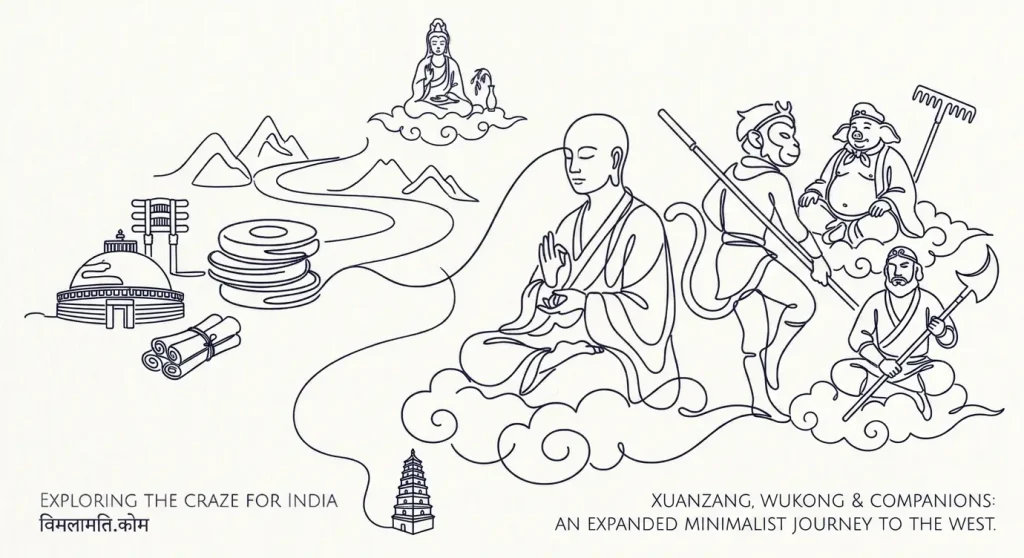
3. Exhaustive Dramatis Personae
The enduring genius of the novel lies in its characters, each functioning simultaneously as a vivid comic archetype, a psychological facet of the human mind, and an alchemical symbol.
| Character Name (English / Chinese) | Symbolic / Psychological Dimension | Signature Attributes & Weaponry | Spiritual Arc |
|---|---|---|---|
| Sun Wukong (孫悟空 / “Monkey King”) | The Restless Mind (Citta) Dynamic, analytical, prone to anger, but capable of ultimate liberation. | Ruyi Jingu Bang (compliant gold-hooped iron cudgel), 72 polymorphic transformations, cloud-somersault. | Starts as an ego-driven rebel; achieves enlightenment as the Victorious Fighting Buddha. |
| Tang Sanzang (唐三藏 / “Tripitaka”) | The Fragile Ego (Jīva) Pious but physically weak, easily deceived by appearances, representing human vulnerability. | Nine-ringed monk’s staff, patchwork cassock, the magical headband used to control Wukong. | The physical vehicle of the mission; achieves Buddhahood as the Buddha of Sandalwood Merit. |
| Zhu Bajie (豬八戒 / “Pigsy”) | Base Appetite (Kāma) Lustful, lazy, gluttonous, representing physical desire and survival instincts. | Nine-tooth iron rake (Jiuchidingshi), transformation into 36 forms. | Constantly tempted to abandon the quest; eventually named Cleanser of the Altars (gaining a job eating leftovers). |
| Sha Wujing (沙悟淨 / “Sandy”) | Quiet Discipline & Grounding Patient, obedient, representing the calm middle path between Wukong’s intellect and Bajie’s desire. | Crescent-mooned shovel, necklace of skulls. | Serves as the loyal peacekeeper of the group; elevated to the status of a Golden-Bodied Arhat. |
| Yulong (玉龍 / “White Dragon Horse”) | The Silent Engine of Progress The third son of the Dragon King of the West Sea, transformed into Sanzang’s mount. | Draconic shapeshifting (rarely used, mostly remains a horse). | The unsung physical carrier of the spiritual load; restored and elevated to a celestial dragon. |
4. Literary Merits & Intellectual Highlights
To the untrained eye, Journey to the West is a playful fantasy adventure. To the literary scholar or Indologist, however, it is an incredibly sophisticated, multi-tiered text containing layers of profound depth:
The Tri-Religious Syncretism
The novel operates on a fluid, “Three Teachings in One” (三教合一) framework, blending Buddhism, Daoism, and Confucianism.
- The Buddhist Layer: The entire journey is an allegory for the realization of śūnyatā (emptiness), as hinted by Wukong’s name (“Awakened to Emptiness”). The eighty-one trials represent the purging of karmic obstacles.
- The Daoist Layer: The text is saturated with the vocabulary of internal alchemy (neidan). Wukong represents “Mind Monkey” (心猿), while Bajie represents “Will Horse” (意馬) or “Wood/Lead” and “Fire/Mercury” in state-of-the-art Ming-era alchemical poetry.
- The Confucian Layer: The journey is a study in social responsibility, filial piety to the master, and the harmonious integration of disparate personalities into a functioning mini-society.
Biting Bureaucratic Satire
Wu Cheng’en (or the anonymous author) uses the celestial realm to stage a devastating parody of the Ming Dynasty’s imperial bureaucracy. Heaven is not a sublime state of mystical ecstasy; it is an administrative nightmare run by the Jade Emperor.
There are offices, registries, files, and territorial jurisdictions. Demons on Earth are frequently revealed to be the escaped pets or mounts of high-ranking celestial officials who slipped away because the heavenly gatekeepers were negligent or corrupt. The satire reaches its peak when the pilgrims finally arrive in the Western Heaven, only to find the Buddha’s disciples demanding a bribe before they will hand over the holy scriptures.
Structural and Linguistic Virtuosity
The novel’s linguistic register constantly shifts between highly colloquial, comedic vernacular prose and exquisite, classical shi and ci poetry. The poems are not merely decorative; they serve as philosophical commentaries on the narrative action, describing battles, landscapes, and inner alchemical states with rigorous classical metrics.
5. Bibliographical Chronology: Major Printed Editions
The textual history of Journey to the West is as complex as the pilgrimage itself. Below is a detailed chronological overview of its key historical and modern editions:
| Date / Era | Title / Edition Name | Publisher / Editor | Literary Significance & Features |
|---|---|---|---|
| Late 13th Century (Song/Yuan Dynasty) | The Story of Sanzang of the Tang Dynasty Retrieving Scriptures (大唐三藏取經詩話) | Kozan-ji Temple Manuscript (Japan) | The earliest known proto-version of the narrative. Highly abbreviated; features a “Monkey Pilgrim” (猴行者) who is an active talker, but lacks Zhu Bajie entirely. |
| c. 1592 (Ming Dynasty) | Newly Printed, Illustrated, Deluxe and Large Character, Journey to the West (新刻出像官板大字西遊記) | Jinling Shidetang (金陵世德堂), Nanjing | The canonical first complete edition. Comprises 100 chapters divided into 20 scrolls (juan). It famously omits Sanzang’s birth/youth story (later inserted as Chapter 9 in Qing editions). |
| c. 1600s (Late Ming) | Li Zhuowu Critique Edition (李卓吾評本西遊記) | Attributed to Li Zhuowu (philosopher Li Zhi) | Highly prized by scholars. Features extensive margins containing philosophical and literary critiques that analyze the text’s profound underlying syncretic themes. |
| c. 1749 (Qing Dynasty) | The Journey to the West, Newly Interpreted (新說西遊記, Xinshuo Xiyouji) | Edited by Zhang Shushen | An influential edition that reinterpreted the novel as a serious treatise on Daoist self-cultivation and Neo-Confucian self-rectification, pushing back against its reputation as a mere comic novel. |
| C.1942 | Monkey: A Folk-Tale of China | Translated by Arthur Waley (Allen & Unwin) | The historic first major English translation. Highly abridged (30 chapters), omitting the poetry and focus on internal alchemy, but genius in capturing the witty, comic tone of Wukong and Bajie. |
| 1977–1983 / 2012 | The Journey to the West (4 Volumes) | Translated by Anthony C. Yu (University of Chicago Press) | The definitive academic English translation. Completely unabridged, meticulously annotated, translating all the complex classical poetry and restoring the profound Buddhist and Daoist alchemical subtexts. |
6. Fascinating and Little-Known Literary Facts
- The Missing Chapter 9: In the earliest complete 1592 Shidetang edition, the story of Sanzang’s parents—his father’s murder and his mother’s forced marriage—is completely missing. This critical back-story was later grafted into Qing Dynasty editions from earlier folk plays to explain why Sanzang was abandoned in a basket on a river (earning him the nickname “River Float”).
- The “Flesh of Sanzang”: The primary plot engine of the 81 tribulations is the belief among local demons that consuming a single morsel of Sanzang’s flesh will grant absolute immortality. This serves as a brilliant literary inversion of the Buddhist concept of taking “spiritual nourishment” from a holy man or relic.
- A Precursor to Xianxia: Journey to the West is the grandfather of the modern Xianxia (fantasy cultivation) genre. Sun Wukong’s rigorous training under Patriarch Subhuti—learning breathing exercises, avoiding celestial calamities, and mastering the 72 transformations—established the tropes of spiritual cultivation and supernatural ascension that dominate East Asian pop culture to this day.
7. The Ultimate Destination: Emptiness as the Great Awakening
Ultimately, the geographic destination of the Silk Route merges seamlessly with the philosophical climax of the novel. When the pilgrims finally reach the Western Heaven and receive the scriptures, they are dismayed to find that the scrolls are completely blank—wordless pages of pure white paper. While the disciples complain of being cheated, the Buddha gently explains that these “wordless scriptures” are, in fact, the highest and most authentic teachings of all, representing the ultimate realization of śūnyatā (emptiness). Only when Sanzang’s fragile human intellect demands a compromise does the Buddha swap them for written texts. This brilliant narrative masterstroke bridges the dry historical quest of pilgrims like Faxian with the profoundest paradox of Buddhist metaphysics: that the ultimate truth cannot be written, spoken, or captured. In their physical and spiritual return to the East, the pilgrims prove that the arduous, demon-infested path of the Silk Route was never truly about arriving at a geographic destination in India, but about the profound inner transformation of the mind itself.
Excerpt from “Journey to the West”…..
[Reference Notes]
This is the moment when the historical Xuanzang (Sanzang) and his supernatural disciples have successfully completed their journey, attained Buddhahood, and are being assigned their final celestial ranks.
Throughout the 100 chapters, Sun Wukong (the Monkey King) was controlled by a magical golden headband (the Tight-Fillet) that his master, Sanzang, would shrink by chanting a spell whenever Wukong misbehaved. Now enlightened, Wukong asks his master to finally take it off.
The Final Philosophical Exchange
“Master, now that I have become a Buddha, I should be just like you. I hope you won’t keep that Tight-Fillet on my head anymore, and that you won’t go on reciting that ‘Tight-Fillet Spell’ to torment me. Please take it off quickly!”
Sanzang smiled and said:
“At that time, it had to be used to constrain you because you were difficult to control. But now that you have achieved Buddhahood, it has vanished of its own accord. How could it still be on your head? Have a look for yourself.”
Wukong reached up and felt his head. Indeed, the band was gone.
“當時只爲你難治,故鑄此法件規制你。如今等成佛,自然去矣,豈有還在之理
Pinyin: > “Dāngshí zhǐ wèi nǐ nán zhì, gù zhù cǐ fǎ jiàn guīzhì nǐ. Rújīn děng chéng fó, zìrán qù yǐ, qǐ yǒu hái zài zhī lǐ?”
English Translation: > “At that time, the band was forged only to discipline you when you were wild. But now that you have realized your own Buddha-nature, it has vanished of its own accord. For how could there be any logical reason for it to remain?”
— Tang Sanzang (Tripitaka) to Sun Wukong, Journey to the West, Chapter 100
Explore the more details about Anthony C. Yu’s scholarly edition….
